

Much like Marmite, AI can be polarising. As someone who loves tech, I can’t help but be in awe of artificial intelligence and how quickly it is developing. Just look at these images of me and my family which were created not long after AI apps hit the mainstream! Like most people, I was initially swept up in the novelty of the experience and tested a number of generators.


I don’t know about you, but if I look as kick-ass as the veteran warrior below, I would honestly have no problems with ageing. The viking simulator is not bad either… those pics kind of resemble me on a good cosplay day. In fact, a few AI images look so much like me that I sometimes do a double-take and wonder if they’re copies of real photos I’d somehow forgotten were in my albums.


However, I am less impressed by the photo-realistic ones than those more stylised. After all, if I want an actual picture of me, I’d just take it myself, or get my photographer husband (accustomed to constructing elaborate sets and composites) to do it. What I love most are the anime/disneyfied renderings, such as these below, but I suppose that’s part of the problem.


Copyright Violations
AI art is a contradiction in terms. Art is commonly acknowledged as a form of human expression, so by default, anything wholly produced by non-humans will be relegated outside that category. What AI regurgitates is merely a facsimile, cobbled together with “prompts” using existing styles mined from the blood, sweat, and tears of actual people who have spent years of their lives gaining experience and honing their skills.
Artists are, quite rightly, outraged by the blatant disregard tech companies have regarding intellectual property. While all kinds of theft are concerning, the grumblings of large organisations (like Disney) do not bother me as much as the cries of independent creators who are in danger of losing their bread and butter to cheap imitations (better described as “AI slop”), and often do not have the resources for legal pursuit.
And that’s even before you take into account the amount of energy AI requires…

Environmental Impact
Generating a single image alone can be the equivalent of fully charging your phone, whilst a complex video can use as much fuel as running an average home for three days. For now, AI computing only accounts for 0.5% of global energy consumption, but this is growing rapidly, particularly as developers look to perfect applications. Training an advanced AI model can cost as much as powering 120 homes per year.
With these data centres working flat out, a horrendous amount of water is required to keep them from overheating. This could affect local communities in the vicinity who may run out of water faster than their reservoirs can be replenished. According to the UN, the water depleted by these AI server farms will equal the domestic needs of 1.3 billion people by 2030.


Infringement of Other Rights
There is no doubt that AI poses many dangers. If you have watched Terminator, your first thought is probably a Skynet future, and from the many memes that have made their way onto our screens, you’re not the first. Fortunately, despite news of some Anthropic programs going rogue, we are still safe from that very far-fetched reality (at least for the time-being). However, the way AI can take over humans in multiple roles is by no means fiction. In fact, it is already happening.
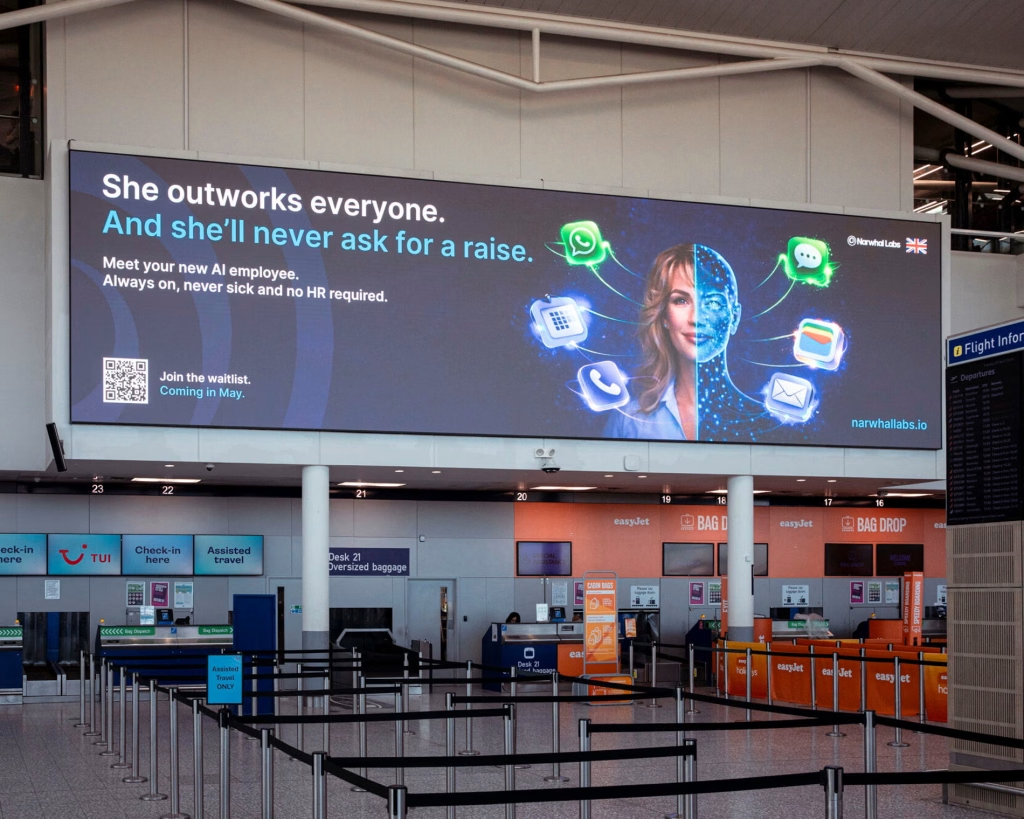
Reports have shown that employers are now utilising AI for low-level jobs instead of recruiting. Some agencies/providers are even blatantly advertising that fact. Junior positions have typically been filled by the young who desperately need the experience, but now find they have no other options. A scary prospect for someone like my daughter, a recent apprenticeship graduate. There are now government initiatives that aim to equip job-seekers with AI expertise, but even that will not be fool proof.
To make matters more disturbing, the likenesses of individuals have been exploited to create pornography and fake images/videos for other nefarious (often political) reasons. While the majority are unmistakably (and risibly) bogus, a few do appear genuine (until further scrutiny). At the rate AI is progressing, it is purely a question of “when” before we find it a greater challenge to distinguish what is and isn’t authentic.
It’s not just children who spend too much time online. Our society as a whole has become over-reliant on tech, from students who hand in essays/assignments completed by AI, to people who believe that these thinking machines can provide advice or companionship.
And the list of problems keeps growing…
During an interview on Radio 4, an expert opined that driverless cars are a solution to a problem that does not exist. The same can be said about AI in general. Whatever tasks it can perform, humans are already capable of doing them. That said, it is undeniable that AI can handle them at far greater speeds (though not always with greater reliability). In some situations, this could save lives, such as when a deep-learning model managed to discover in three days a new powerful antibiotic (called halicin) which would normally take scientists over a decade to achieve by traditional methods.
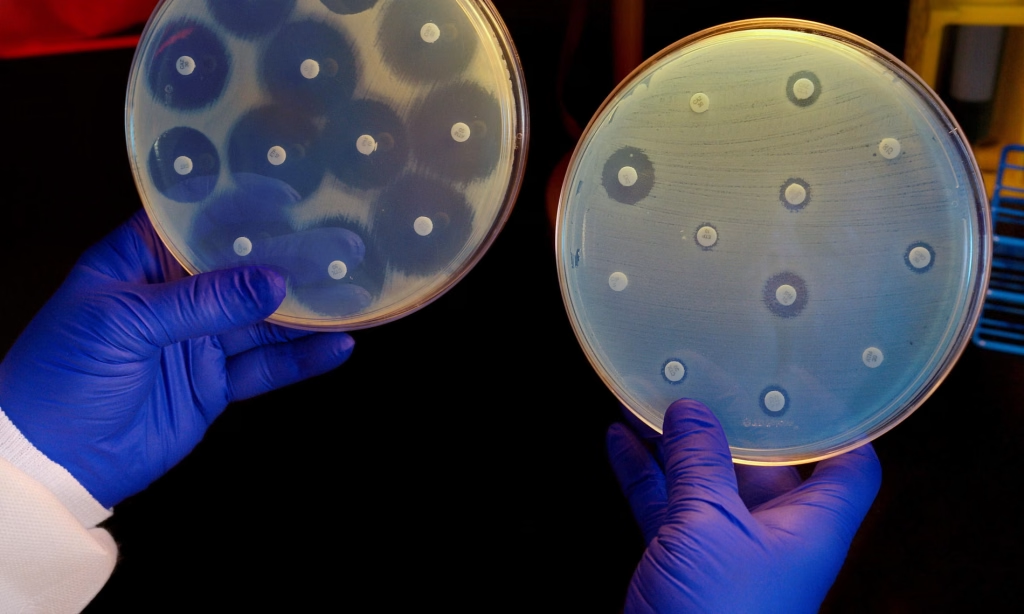
This is far from the only medical breakthrough made possible by AI, and there have also been advancements in other fields such as engineering/architecture and weather/climate science etc. This is one of the reasons I hesitate to be overly-critical, and I can even understand why businesses are so keen on tapping into the vast potential of AI. I believe there is a place for it, but only as a tool to enhance rather than replace existing practices.
The last thing we want is a bunch of ones and zeroes determining every aspect of our lives. Surely everyone is aware that AI lacks a moral compass, and simply cannot be allowed to make choices for us. And yet, the world’s powers have not been proactive. As this is a global predicament, only international statutes will be effective. With artificial intelligence progressing at such an alarming rate, it is frankly mind-boggling that no plan has yet been put forth to regulate it. If we do not draw the line now, we’ll soon reach a point where the only hope to fix our mistakes is a time machine. Perhaps AI can help with building that.